
Finance Minister Nirmala Sitharaman will have to do a tight-rope walk between staying fiscally prudent and general public expectations of lower taxes and a wider social security net, while at the same time firing the engines of the economy before general elections. Sitharaman will on Wednesday present her fifth straight Budget at a time when the economy is slowing due to global headwinds and specific sectors need attention. In the run-up to the Budget presentation, expectations are rife that she may tweak income-tax slabs to provide relief to the middle class and increase spending on the poor through programmes such as the rural job scheme while ramping up financial incentives for local manufacturing.

The agency had received Rs 946.51 crore to manage its affairs in the Budget Estimates for 2023-24, which was later increased to Rs 968.86 crore in the Revised Estimates.

The BJP accused Congress leaders of colluding with foreign forces to destabilize India and demanded Sonia Gandhi to disclose her role in a George Soros Foundation-funded organization's activities. The ruling party also attacked Rahul Gandhi, calling him a "pawn" for his protests against the Adani issue.

The total allocation to the defence sector is 12.9 per cent of the total budget of the government of India for the financial year 2024-25.

'I found it unbelievable that L&T said 45,000 jobs were waiting to be filled because of unavailability of suitable skillsets.' 'So, when the Opposition sweepingly says there are no jobs, I'm sorry... I'm not saying it's raining jobs, but there are jobs. The (skill) gap has to be bridged.'

This is due to the newly formed Union Territories of Jammu and Kashmir, and Ladakh, which will get funds from the Centre's share, which means devolution will be for 28 states compared to 29 earlier.

Kailash Gahlot, a key minister in the Aam Aadmi Party (AAP) government in Delhi, has resigned, potentially impacting the party's ambitious plan to roll out a Rs 1000 monthly honorarium scheme for women ahead of the Assembly polls in February. Gahlot, who represented the Jat-dominated Najafgarh constituency in West Delhi, cited several issues, including the "Sheeshmahal" controversy over his former official residence, the Delhi government's tussle with the Centre, and the failure to clean the Yamuna River, in his resignation letter. Delhi BJP leaders welcomed Gahlot's resignation, fueling speculation that he could join the party before the assembly polls. However, AAP leaders claimed Gahlot resigned due to pressure from central agencies, including the Enforcement Directorate, and that joining the BJP was his last option. Gahlot's resignation has sparked speculation about his future and the impact it will have on the AAP's electoral prospects.

The massive victory of Bharatiya Janata Party-led Mahayuti in Maharashtra indicates a tactical course correction post the Lok Sabha debacle, with factors like Rashtriya Swayamsevak Sangh's active role in the poll campaign, Ladki Bahin scheme, rise in women voting, and subtle message of Hindutva playing a crucial role.

From highways connecting once-remote regions to aviation networks carrying millions, India's infrastructure story is one of transformation.

Announcing a Re 1 crop insurance scheme for farmers, the deputy CM said the government will bear the financial burden of Rs 3,312 crore.

The removal of the angel tax is expected to be a boost for startups as it will help in promoting a more conducive environment for them.

These schemes will be based on enrolment in Employees' Provident Fund Organization (EPFO), Sitharaman said in the Lok Sabha.

The finance minister will also visit the school in Tamil Nadu where she studied from KG to Class 5.
'Is the Agniveer scheme or their post-retirement re-employment in paramilitary forces or in the state governments the BJP's answer to the crying need on the job front?' 'Or, even Finance Minister Sitharaman's one-year internship scheme in the public and private sector, is it a permanent solution, either?', asks N Sathiya Moorthy.

on Thursday adjourned sine die, ending the four-week-long second leg of the Budget session, during which treasury and opposition members locked horns over Rahul Gandhi's 'democracy' remark and the Adani issue.

Finance Minister Nirmala Sitharaman on Monday called on President Ram Nath Kovind before presenting the Union Budget 2021-22. As per established tradition, the Finance Minister met the President at the Rashtrapati Bhawan before heading to Parliament. The Union Cabinet will meet at 10.15 am to clear the Budget.

Evidently, households see a brighter future after the Budget, reveals Mahesh Vyas.

The government on Tuesday proposed to extend the period of incorporation of eligible startups by one more year till March 31, 2023 for providing tax incentives, a move aimed at encouraging budding entrepreneurs. Finance Minister Nirmala Sitharaman in her Budget speech said startups have emerged as drivers of growth for the economy and over the past few years, the country has seen a manifold increase in successful startups. Eligible startups established before March 31, 2022 had been provided a tax incentive for three consecutive years out of ten years from incorporation.
He said government has taken measures to augment revenues, especially through tightening tax administration.

The finance minister could well be on her way to setting a record of achieving the biggest single-year reduction in the government's fiscal deficit, explains A K Bhattacharya.

The Budget would have been the perfect vehicle to introduce some bold initiatives.
That opportunity has been lost through this Budget, observes Shreekant Sambrani.

Most of the members, including Prime Minister Narendra Modi, were seen wearing face masks. However, members had crowded the Lok Sabha chamber, while hardly a handful of others, including union ministers Dharmendra Pradhan and Piyush Goyal, were seen seated in the Rajya Sabha chamber.

Here are the key numbers to watch out for in the Budget for 2022-23, which is widely expected to boost spending towards policies that create jobs, boost manufacturing, helping rural and agri-economy and infrastructure creation. Sitharaman, who had in her first budget in 2019 replaced leather briefcase -- which had been in use for decades for carrying budget documents -- with a traditional red cloth 'bahi-khata', has spurt in tax collections to her aid in the budget that is expected to a spend-all budget.

'For me, if I want to buy a house to stay, I don't care about indexation because I don't want to sell that house.' 'The only thing that matters to me as a buyer is that the home price should be within my reach.' 'Any market, when speculators and investors go out, it will benefit the middle class.'

'It would be reasonable to assume that Modi 3.0 would be more focused on projects and schemes which do not require any legislative change or which have the support of its coalition partners,' asserts A K Bhattacharya.

'Retail investors, who had not seen such a massive correction in the SMID universe since COVID-19, are witnessing something like this for the first time. Panic profit booking may continue.'
Subhash Chandra Garg, the former finance secretary who was shunted out of the finance ministry within three weeks of Modi-2.0 government's first budget last year, on Saturday alleged that new Finance Minister Nirmala Sitharaman got him transferred out.
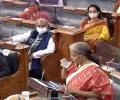
It was also the shortest speech by Sitharaman, who had delivered the longest speech last year. Her first Budget speech in July 2019 went on for around 137 minutes and in 2020, it went on for more than 160 minutes and was cut short after she felt unwell.

The government on Tuesday announced Rs 900-crore allocation in the Budget for the newly set up Ministry of Cooperation for the 2022-23 fiscal, besides slashing Alternate Minimum Tax (AMT) on cooperative societies to 15 per cent and surcharge to 7 per cent, which nodal minister Amit Shah hailed saying it will boost the sector. Of the total allocation for the next fiscal, a significant amount of Rs 350 crore has been provided for digitisation of Primary Agriculture Cooperative Societies (PACs), while Rs 274 crore for an umbrella scheme 'Prosperity through Cooperatives' which would have a number of sub-components with the aim of all-round development of cooperatives in the country. For the first time, a separate budget of Rs 11 crore has been provided to Vaikunth Mehta National Institute of Cooperative Management (VAMNICON).
 © 2026 Rediff.com - Advertise with us - Disclaimer - Privacy Policy - Sitemap - Feedback - About us - Terms of use - Grievances